
Celebrating Is Political!
Berlin, 25 July 2026
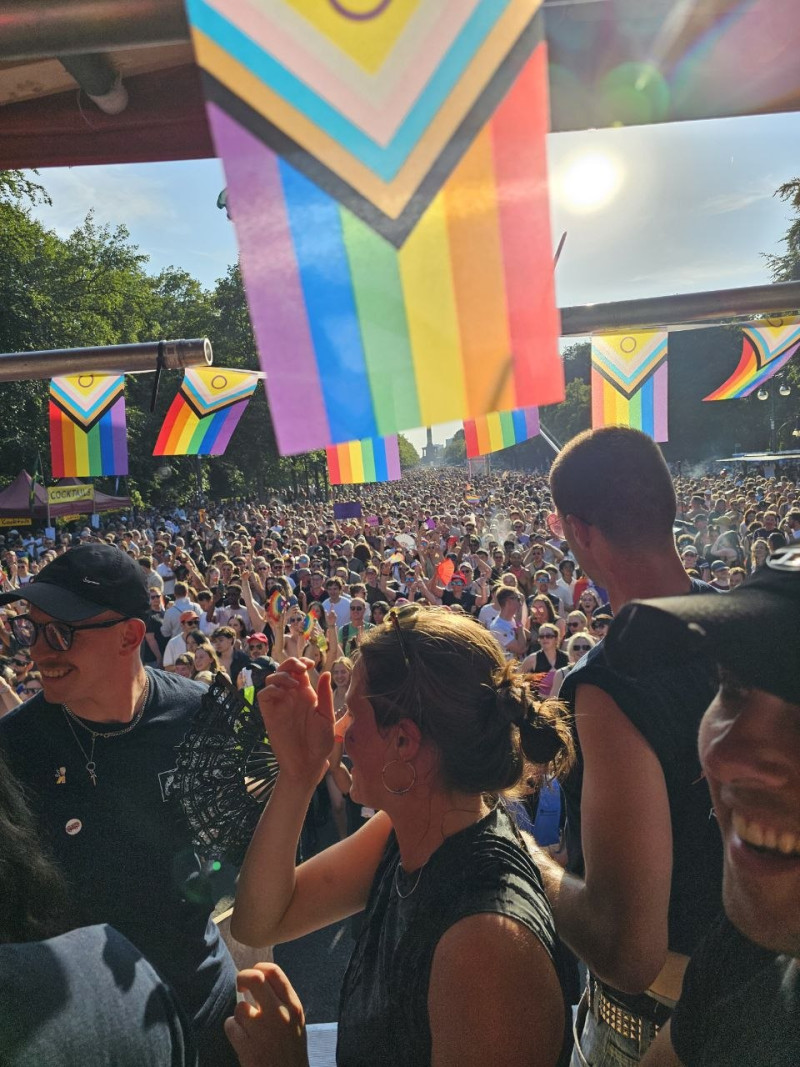
Berlin Pride (Christopher Street Day, or CSD) 2026 was a day filled with joy, visibility and solidarity. Hundreds of thousands of people came together to celebrate diversity, freedom and queer life. Yet by the evening, the day had ended in what authorities are investigating as an Islamist-motivated terrorist attack, leaving many people deeply shocked – ourselves included.
In this article, we would like to share what we experienced, outline the facts that are currently known, and explain why this day reminded us once again of a simple truth:
Celebrating is political.
Two Pride Marches in Berlin
For many years, Berlin has hosted two different Pride demonstrations.
The first is the large Berlin CSD, attracting several hundred thousand participants and dozens of parade floats. Over time, it has also become increasingly commercial.
The second is the much smaller, more explicitly political Internationalist Queer Pride, which this year took place in the district of Wedding.
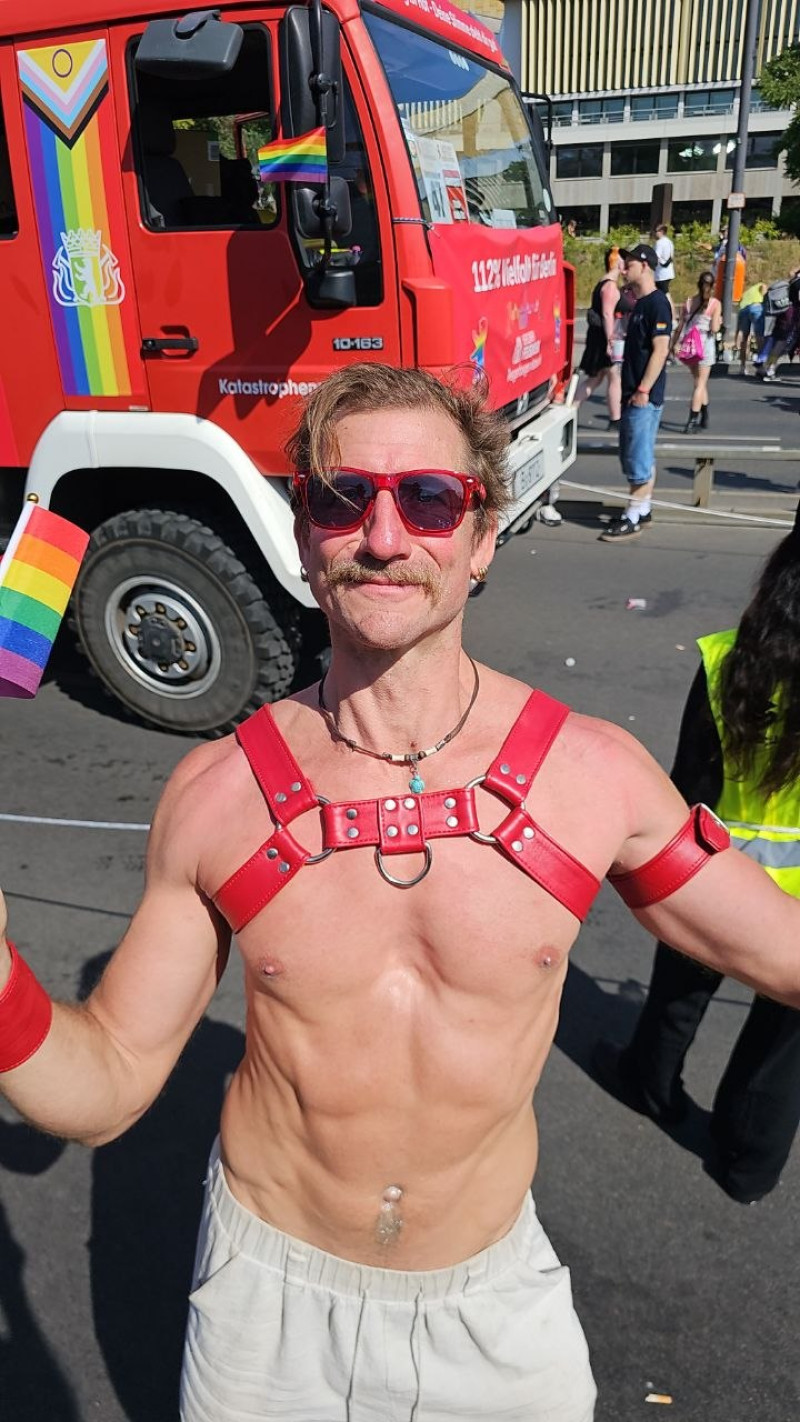
Some of us joined the political Pride march in Wedding. At the same time, a small group from our team had been invited by the Berlin Fire Brigade to accompany Float No. 47 in the main Berlin CSD parade, walking both on and alongside the vehicle.
This gave us the rare opportunity to experience both demonstrations at first hand—each with its own atmosphere, priorities and challenges.
This is the story of that day.
Our Day at Berlin Pride
According to the parade schedule, we had to report to the assembly area by noon. After a highly professional safety briefing delivered by a rather attractive firefighter—which naturally caused a fair amount of amusement within our little group—we received our wristbands and prepared for the parade.
Between noon and 1:30 pm, every float tested its sound system. Leipziger Straße gradually turned into a sea of music, voices and anticipation before the procession slowly began to move.
Our route took us via Potsdamer Platz towards Nollendorfplatz, one of Berlin's historic centres of queer life. We did not reach Kurfürstenstraße until around 5 pm, arriving at Nollendorfplatz about half an hour later. From there, the parade continued along Helmut-Kohl-Allee towards the Victory Column.
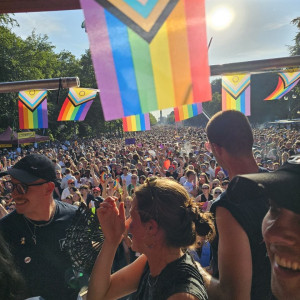
At that point, the procession split into different routes. As one of the final floats, we continued towards the Brandenburg Gate.
People lined the streets everywhere.
Hundreds of thousands of them.
It was not merely something you could see—it was something you could feel.
People of every age, background and identity had come together to celebrate diversity, love and mutual respect. This year's official Berlin CSD motto was: "Conviction is hot."
The Signs We Will Never Forget
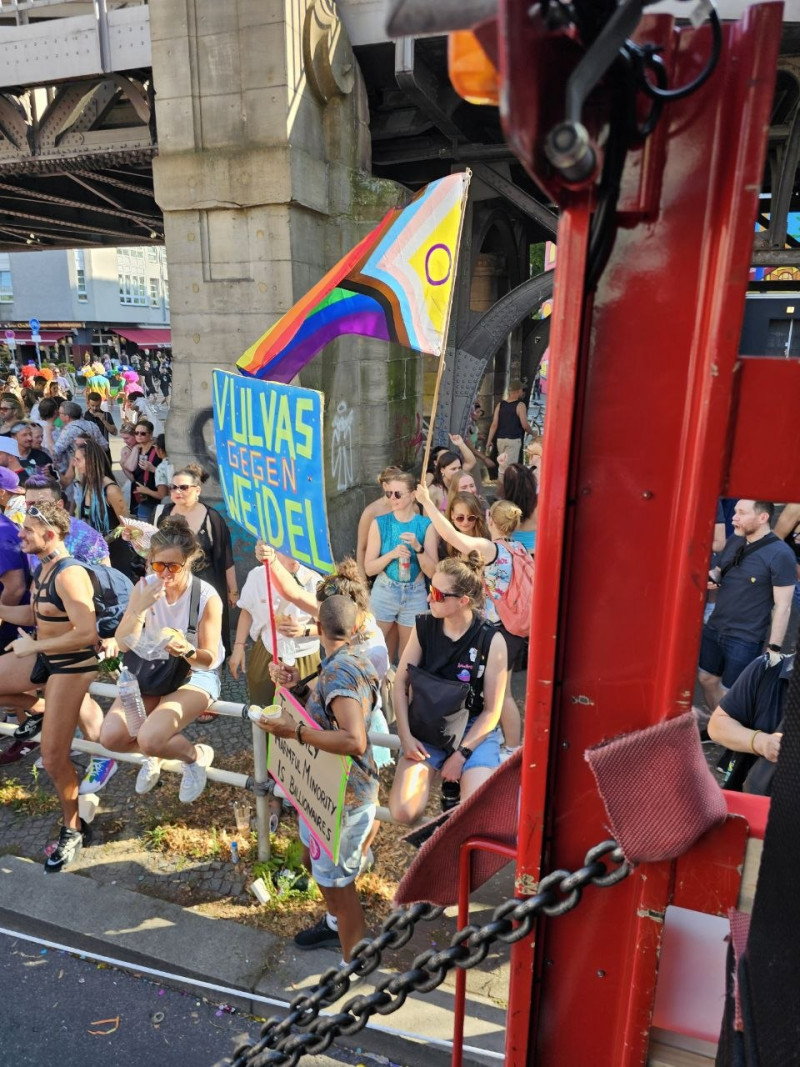
Among the most memorable aspects of the day were the countless creative, witty and courageous protest signs. Three messages, in particular, have stayed with us.
One sign read:
"Vulvas against Weidel."
Provocative, humorous and unmistakably political, it expressed opposition to the policies associated with Alice Weidel, co-leader of the far-right party Alternative for Germany (AfD), whose positions are widely criticised for marginalising LGBTQ+ people.
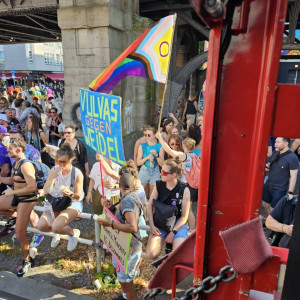
Another sign perhaps captured the very essence of Pride even more clearly:
"Respect my existence or expect my resistance."
These words perfectly reflect what Pride has stood for ever since its beginnings: visibility, self-determination and the courage to resist discrimination and hatred.
A third sign made us smile:
"Sick until the end of Merz – but healthy enough to fight for my rights."
This slogan contains a play on words that is almost impossible to translate directly. In German, "krank bis Ende März" ("off sick until the end of March") is a familiar phrase. Here, März ("March") is replaced by Merz, referring to German Chancellor Friedrich Merz.
The slogan also alludes to the idea of taking sick leave as a form of political protest—an idea that has been discussed in left-wing circles in Italy as a symbolic act of resistance against the government of Prime Minister Giorgia Meloni. The joke is that the speaker intends to remain "off sick until the end of Merz"—in other words, for as long as Merz remains in office—while being perfectly healthy when it comes to standing up for their rights. It is a wonderful example of how Pride has always used humour, satire and creative wordplay to express political dissent while strengthening solidarity within the community.
What Happened That Evening
At around 8:30 pm, we left our float and made our way home.
While the closing event at the Brandenburg Gate was still in full swing, the situation changed dramatically.
Shortly after 10:15 pm, the event was brought to an abrupt halt. Visitors were asked to leave the area immediately and, in particular, to avoid the vicinity of the Victory Column.
Soon afterwards, reports emerged that a suspected Islamist-motivated terrorist attack had taken place in Berlin's Tiergarten park.
According to the information released by the investigating authorities, a 21-year-old German citizen of Lebanese family background drove a van into a crowd of people before attacking others with a machete. A 65-year-old Polish woman was killed. Thirty-one people were injured, three of them critically.
The suspect had previously been known to the authorities as an Islamist extremist and had received a suspended youth sentence the previous year for preparing a serious act of violence endangering the state. Following a large-scale manhunt, he was located on Sunday evening in a Berlin allotment garden in the district of Spandau. When he reportedly advanced towards police officers carrying a bladed weapon, members of the Special Deployment Command (SEK) opened fire. He died at the scene. Germany's Federal Public Prosecutor continues to investigate whether other individuals may have been involved or had prior knowledge of the attack.
The Highly Political Pride March in Wedding
While the main Berlin CSD attracted hundreds of thousands of participants, the Internationalist Queer Pride began in Wedding at 3 pm.
According to the police, around 7,000 people took part. Several hundred police officers were deployed to the event, creating a noticeably different police-to-demonstrator ratio from that at the main Pride march, where the terrorist attack later occurred.
After repeated chants of the slogan "From the River to the Sea, Palestine Will Be Free"—a phrase that has been banned in Germany under certain circumstances because of its legal assessment in relation to Hamas —the police arrested one participant. When others attempted to prevent the arrest, officers used pepper spray and physical force. In total, nine people were arrested, and the march was halted for several hours.
As a result, a significant number of police officers were occupied with policing this comparatively small demonstration, while around 1,700 officers were deployed to accompany the main CSD, where hundreds of thousands of people were celebrating peacefully.
Later that evening, the attack took place.
The Shock Afterwards
When we arrived home at around 11 pm and read the first news reports, we were stunned.
The following morning, the first messages began arriving from men who had registered for our Tantastic! evening event. One message, in particular, has stayed with us:
"I'm completely frozen. Inside I'm overwhelmed with emotion, but at the same time I feel paralysed."
Many of the men who attend our events are highly sensitive people. Some carry painful experiences of exclusion, violence or rejection.
When queer people once again witness an event celebrating visibility and joy becoming the target of deadly violence, old wounds are reopened. Alongside grief for the victims comes fear.
Fear of further violence.
Fear of growing extremism.
And with regional elections approaching in several German states, many are also asking themselves how German society may change in the years ahead—and what place queer people will have within it.
These concerns are becoming an increasingly frequent topic in our conversations.
Celebrating Is Political
Pride has never been "just a party".
When the first Christopher Street Day demonstrations took place in Germany in 1979, only around 80 to 100 people marched in Berlin and Cologne. Those early gatherings were acts of protest against discrimination, exclusion and state oppression. To be visible, to walk through the streets together and to celebrate one's identity was—and still is—a profoundly political act.
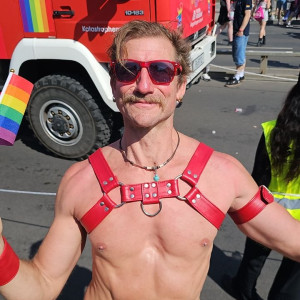
In this context, celebrating means:
We refuse to hide.
We show that we exist.
That we love.
That we are diverse.
And that we deserve the same rights, the same dignity and the same security as everyone else.
Celebration creates community. It makes minorities visible and strengthens solidarity. That is precisely why hatred so often targets places where openness, diversity and freedom are celebrated.
Berlin Pride 2026 reminded us once again how closely joy and vulnerability can coexist.
A single day held both exuberant celebration and unimaginable violence.
It reminded us that progress can never be taken for granted—and that the freedoms many people enjoy today were won because others had the courage to stand up, become visible and refuse to be intimidated.
That is precisely why we must not allow fear to take away our joy.
Because visibility is more than colourful flags and glitter.
Visibility is an act of courage.
Visibility is a commitment to equality.
Visibility is hope.
And that is why one truth remains:
Celebrating is political.